
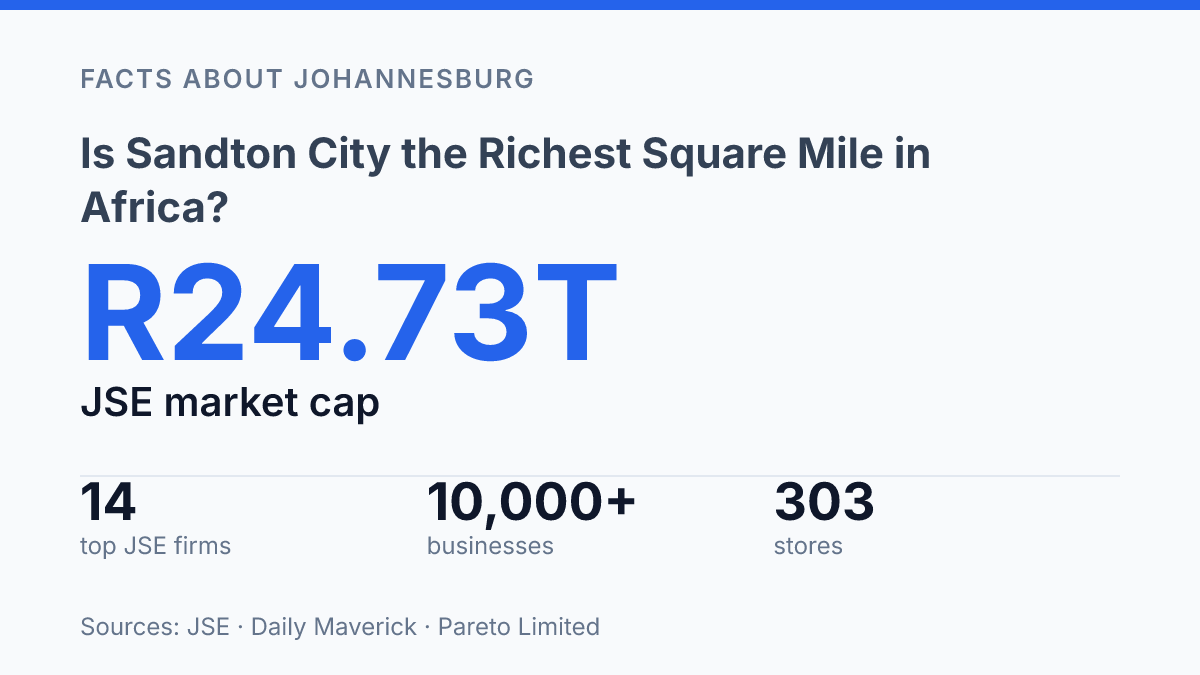
Is Sandton City the richest square mile in Africa? is a claim with a stronger basis in Johannesburg’s 11,700 resident dollar millionaires than in any official one-square-mile calculation. The Africa Wealth Report 2025 ranks Johannesburg as the continent’s wealthiest city, with 24 centi-millionaires and 2 billionaires, and describes much of that wealth as anchored by the Sandton business district. Yet the phrase becomes less precise when Sandton City is treated as the mall rather than the wider commercial node, or when “richest” is judged by prime property prices, office rents, or future wealth growth.
Cape Town already leads Africa for prime residential pricing at about US$5,800 per square metre, while Lagos commands far higher prime office rents than Johannesburg. The question is therefore not whether Sandton is wealthy, but what kind of wealth the phrase is actually measuring.
What the phrase “richest square mile” actually means
The most consequential word in the claim is not “richest” but “square mile,” because no official African economic table ranks Sandton by that unit. In practice, the phrase “richest square mile in Africa” functions as a promotional and journalistic shorthand for the concentration of money, corporate activity, high-end retail, and office development around Sandton in Johannesburg. Its use is tied less to a mapped one-square-mile boundary than to the broader Sandton central business district, which is commonly treated as the symbolic centre of Johannesburg’s private-sector economy.
Sandton City is the retail complex most often linked to the phrase, but the mall is only one part of the claim. Pareto Limited lists the centre as having 147,941 m² of retail gross lettable area, 303 stores, 8,069 parking bays, and associated office and mixed-use space, after opening in 1973. Those figures support its status as a major commercial asset, but they do not by themselves prove that the surrounding district is the wealthiest urban square mile on the continent.
Different measurements can produce different interpretations of “richest.” If the claim refers to commercial property, the relevant evidence would include building valuations, office rents, occupancy, and total lettable space.
If it refers to corporate power, the focus shifts to the number of listed-company offices, financial firms, and headquarters in Sandton Central. Daily Maverick reported in 2025, in a Standard Bank-sponsored feature, that Sandton Central contains more than 10,000 businesses, 1.1 million m² of commercial space, and 14 of the JSE’s top 100 companies by market capitalisation, which is a stronger basis for the phrase than the mall alone.
Consumer spending is a separate question. A luxury retail concentration at Sandton City may signal affluent shoppers and high sales potential, but a defensible ranking would need comparable turnover, spend per square metre, or footfall data across rival African malls and districts. Without that like-for-like evidence, the phrase should be read as a widely repeated description of economic concentration rather than a formal statistical title.
Why Sandton is associated with extreme wealth
Sandton’s wealth reputation rests on an unusual overlap: the Johannesburg Stock Exchange sits close to luxury retail floors, premium office towers, and some of Johannesburg’s highest-income residential addresses. The financial-market presence is not symbolic only; the JSE says it supports more than 263 listed companies with total market capitalisation of R24.73 trillion, making it Africa’s largest exchange and placing it among the world’s top 20 by market capitalisation. That scale helps explain why the district is treated as a proxy for South African corporate power rather than merely as an affluent shopping node.
The corporate profile is reinforced by high-profile headquarters and major offices, including Discovery, Nedbank, and Investec. These institutions draw senior executives, professional services firms, asset managers, insurers, and banking operations into a compact business district, raising demand for premium office space and supporting the surrounding hospitality and retail economy. In 2025, the Henley & Partners and New World Wealth, Africa Wealth Report ranked Johannesburg as Africa’s wealthiest city, with 11,700 resident dollar millionaires, 24 centi-millionaires, and 2 billionaires, even after a 35% fall in its millionaire population since 2015.
Property values give the reputation a more tangible base. Business Day reported that Johannesburg’s valuation appeal process was asked to reconsider a R10 billion municipal valuation of Sandton City, with one expert valuation exceeding the owners’ expert’s figure by about R2 billion. A municipal valuation is not the same as a market sale price, but it indicates the scale of the asset under discussion and the level at which the precinct is assessed.
Luxury commerce and nearby residential wealth complete the picture. Sandton’s high-end retail mix serves corporate visitors and affluent households from areas such as Sandhurst and Bryanston, linking office demand, consumer spending, and private wealth in one urban cluster. That concentration strongly supports Sandton’s association with extreme wealth, but it does not by itself prove that the area has the highest total wealth of any district in Africa.
How Sandton compares with other wealthy African districts
On office rents, Lagos outpaces Johannesburg by a wide margin: Knight Frank’s Africa Office Market Dashboard for H2 2025 put Lagos prime office rents at US$55/m²/month, compared with US$13–17/m²/month for Johannesburg. In comparisons with Victoria Island and Ikoyi, the closest public benchmark is usually the Lagos prime-office market rather than a audited district-by-district table.
That distinction matters because higher rent can reflect scarcity, currency pricing, tenant demand, and development costs, not only overall wealth. Even so, the data weakens any simple claim that Sandton sits above every African business district on commercial-property pricing.
Residential wealth points to a different set of rivals. Henley & Partners and New World Wealth reported in 2025 that Cape Town had Africa’s highest prime residential prices, at about US$5,800 per square metre, and led the continent for centi-millionaires with 35. Those figures do not measure a single Cape Town square mile against Sandton City, but they show that affluent Cape Town enclaves can exceed Johannesburg-linked areas on luxury housing values and ultra-high-net-worth concentration.
The same caution applies to Ikoyi and Victoria Island in Lagos, as well as high-end districts in Cairo and Nairobi. These areas may rank strongly on private residences, land values, embassy districts, corporate offices, or expatriate rental markets, depending on the metric selected. A financial district, a luxury residential suburb, and a premium retail precinct are not directly comparable unless the same indicator is measured across each one.
Africa does not have a single, continent-wide wealth index for urban districts that combines office rents, retail turnover, property valuations, private wealth, and corporate density into one transparent ranking. As a result, Sandton can be described as one of Africa’s most prominent concentrations of business and wealth, but direct comparisons show a more mixed picture: Lagos may lead on prime office rents, Cape Town on top-end residential pricing, and other districts may dominate narrower local measures.
So, is the claim accurate?
The evidence supports the reputation more strongly than the ranking. Sandton City and the surrounding Sandton business district can fairly be described as one of Africa’s wealthiest commercial nodes because the indicators considered earlier point in the same direction: concentrated corporate activity, premium retail, high-value property, and a close connection to Johannesburg’s private-wealth base.
That conclusion is narrower than the slogan often implies. The phrase works best as a compact description of status, visibility, retail intensity, and corporate concentration. It captures why Sandton is widely treated as a symbol of South African commercial wealth, but it does not prove that a defined square mile there outranks every comparable district on the continent by a consistent economic measure.
A strict ranking would require a common method for comparing districts across countries. The result could change depending on whether “richest” means retail turnover, office rents, land values, resident wealth, company concentration, luxury property pricing, or financial-market influence. Earlier comparisons show that Sandton is exceptionally strong on some of these measures, while other African centres can lead on others.
The most accurate conclusion is therefore qualified: Sandton City and its surrounding district are defensibly among Africa’s leading concentrations of commercial wealth, but the claim is not verified as a literal continental first-place ranking. It is best read as an evidence-backed statement of prominence, not as a settled statistical title.
Where the richest-square-mile claim still holds weight
The label remains useful as shorthand, but weak as a measurement. Sandton’s strongest claim rests on concentrated private wealth, corporate presence, and financial-market proximity rather than a defined square-mile boundary or a single asset-value ranking. That distinction matters because Africa’s wealth map is shifting: Cape Town leads in prime residential prices and centi-millionaires, while Johannesburg’s millionaire population fell 35% between 2015 and 2025.
If Cape Town does overtake Johannesburg in total wealth by 2030, the phrase may survive more as a brand of financial status than as a current economic description. Sandton’s reputation is real, but its exact wording asks more of the evidence than the evidence can cleanly provide.
Frequently Asked Questions
Q: Why is Sandton often called Africa’s richest square mile?
A: The label comes from Sandton’s concentration of corporate headquarters, high-end retail, and premium property values. It has long been associated with Johannesburg’s financial core, which gives the area an outsized reputation compared with its small geographic size.
Q: Is Sandton City the richest square mile in Africa?
A: The phrase is often used loosely, but it is not a formally measured or universally accepted ranking. Sandton as a district is better understood as one of Africa’s wealthiest business areas rather than a place with an official wealth title attached to the mall alone.
Q: What makes Sandton economically important?
A: Sandton hosts major banks, listed companies, luxury hotels, and some of South Africa’s most valuable commercial property. That mix concentrates capital, jobs, and spending power in a relatively small area, which is why it carries such strong economic weight.
Q: Is Sandton richer than central Johannesburg?
A: Sandton generally has higher commercial property values and a denser concentration of corporate wealth than central Johannesburg. Central Johannesburg remains economically significant, but the two areas serve different roles within the metro economy and are not directly comparable on a single measure of wealth.
Q: What does the phrase ‘square mile’ mean in this context?
A: In this context, the phrase is a descriptive nickname rather than a precise land measurement. It is used to signal a compact area with unusually high levels of business activity, property value, and spending power.