
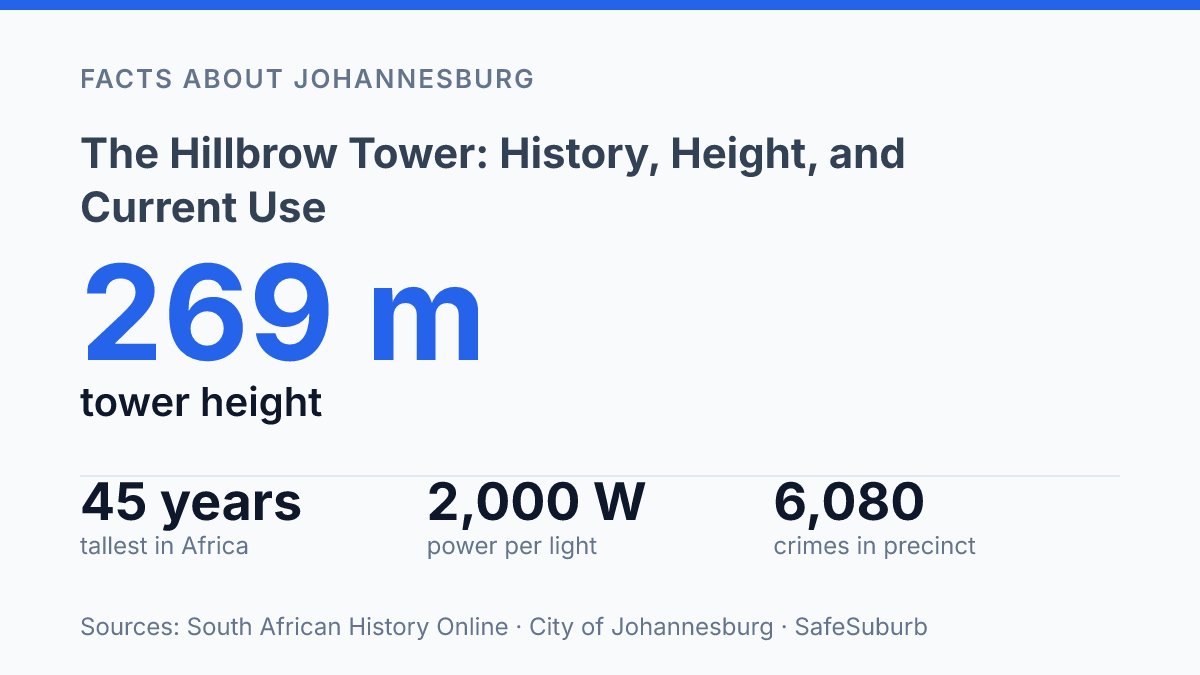
The Hillbrow Tower reached 269 metres in 1971 and then held Africa’s height record for 45 years, a technical fact that explains why one Johannesburg structure still carries more weight than its closed observation floors suggest. Built from a 232-metre reinforced-concrete shaft and a 38-metre steel mast, it was designed as both communications infrastructure and a public destination, complete with high-speed lifts, restaurants, and views stretching more than 80 kilometres on clear days.
Its story also tracks a shift in Johannesburg itself: from an engineering showpiece named after JG Strijdom to a Telkom-branded microwave hub in a neighbourhood now discussed as much through security data as through architecture. The article follows that transition through the tower’s construction, naming, skyline role, present function, and the Hillbrow context that shapes how it is understood today.
How the tower was built and named
A telecommunications tower of 269 metres was an unusually ambitious civil-engineering project for Johannesburg at the turn of the 1970s, especially because its concrete shaft had to support both broadcast equipment and a steel mast above the city. Construction of The Hillbrow Tower began in June 1968 and was completed in April 1971, according to South African History Online. The same source records the project cost at R2 million, then equivalent to about US$2.8 million, placing it firmly within the scale of a major state-era infrastructure investment rather than an ordinary urban building project.
Engineering records show why the structure was treated as a technical achievement for its period. The Arup Journal reported in 1973 that the tower consisted of a 232-metre reinforced-concrete tower topped by a 38-metre steel mast.
Its foundations used eight shafts, each 3.2 metres in diameter, sunk 42 metres deep, while the structure’s approximate mass was 19,050 metric tons. Those figures indicate a design concerned not only with height, but with stability, load-bearing capacity, and the demands of telecommunications equipment at elevation.
The tower was first called the JG Strijdom Tower, after former South African Prime Minister JG Strijdom. That original name reflected the political culture of the period in which the structure was planned and built, when major public works were often linked to state commemoration. Over time, however, the tower’s physical presence in Johannesburg allowed it to acquire a wider civic identity beyond the political reference embedded in its first name.
Why it became a skyline landmark
At 269 metres (883 feet), a communications structure in Hillbrow was the tallest structure and tower in Africa for 45 years and remained the tallest structure in the Southern Hemisphere until 1978, when the 270-metre Mount Isa Chimney surpassed it, according to South African History Online, 2017/updated. That record is central to why the tower became more than a piece of telecommunications infrastructure. Its height placed Johannesburg in a continental comparison, making the structure a measurable point of reference rather than only a local utility.
What the tower does today
A tower once associated with public viewing floors now has a simpler public interface: its exterior remains visible across Johannesburg, while its interior is reserved for network operations. The site is managed by Telkom, and its current function is strictly broadcasting and telecommunications. That operational role means the structure is treated as working infrastructure, not as a mixed-use public building or an urban lookout point.
Telkom’s own description of the tower has emphasised its communications role rather than any visitor function. In a 2005 release reported by ITWeb, the company described it as a microwave traffic hub for Gauteng, carrying inbound and outbound traffic linked to Telkom’s network from major South African centres including Cape Town and Durban. This places the tower within the practical systems that move broadcast and telecommunications signals, which explains why access control is part of its normal operation rather than an incidental restriction.
There is no public access to the interior or observation decks. The City of Johannesburg reported in 2011 that the tower closed to the public in 1981 for security reasons, and that status remains central to how the building is understood today.
The absence of public entry limits its value as a conventional tourist stop, but it also helps protect a facility whose purpose depends on controlled access, equipment security, and uninterrupted service. Its public role is therefore indirect: it is seen as part of the skyline while functioning primarily as a telecommunications asset.
Hillbrow, security, and the tower’s place in the city
Hillbrow Tower is easiest to experience as part of Johannesburg’s skyline rather than as a place to approach on foot. The structure stands in Hillbrow, a dense inner-city suburb of Johannesburg whose name has become inseparable from the tower’s public identity. That location gives the landmark much of its visual power, since it rises directly from one of the city’s most recognisable urban districts, but it also shapes how residents, visitors, and tour operators treat the site in practical terms.
Local security conditions are a material part of that practical reality, though they should be described with care. SafeSuburb’s 2026 page, using SAPS quarterly crime data for the Hillbrow police precinct, recorded 6,080 reported crimes from April 2025 to March 2026, down 8% year on year.
Precinct-level figures do not describe every street or every moment in the suburb, but they help explain why casual sightseeing walks immediately around the tower are not generally presented as a standard tourist activity. Urban management pressures, high density, and local safety concerns all affect how the landmark is accessed and interpreted from ground level.
This context creates a contrast between visibility and approachability. From many parts of Johannesburg, the tower remains a fixed point of orientation, appearing above apartment blocks, commercial streets, and ridgelines.
At close range, however, the experience is shaped less by panoramic admiration and more by access limits, controlled infrastructure, and the character of the surrounding inner city. Its civic presence therefore operates at a distance as much as at the site itself.
The result is that the tower occupies two roles at once: it is a neighbourhood landmark embedded in Hillbrow, and it is a metropolitan symbol readable from well beyond the suburb. That distinction matters because the building’s public meaning has not disappeared with reduced physical access. Even when viewed from outside the immediate area, it continues to mark Johannesburg’s skyline and to signal the city’s layered relationship between infrastructure, urban change, memory, and security.
Why public access is only part of the tower’s meaning
A tower built to receive visitors now matters partly because most people cannot enter it. That absence changes the way the structure is read: less as a tourist platform and more as a fixed point where engineering, telecommunications, corporate identity, and urban risk overlap. Any future discussion about public access, heritage status, or upgraded lighting would have to account for more than nostalgia.
It would need to balance safety, operational demands, and the value of keeping a major city landmark legible from the street. The practical consequence is clear: even without an observation deck, the tower remains one of Johannesburg’s most visible measures of how infrastructure can outlive its original public purpose.
Frequently Asked Questions
Q: How tall is The Hillbrow Tower?
A: The Hillbrow Tower stands at 269 meters, or 883 feet. That height made it one of the most prominent man-made structures in Johannesburg and, for many years, the tallest tower in Africa.
Q: Can visitors go inside The Hillbrow Tower?
A: No public access is currently available to the interior or observation decks. The tower functions strictly as a broadcasting and telecommunications facility, so it is not open as a tourist attraction.
Q: What was The Hillbrow Tower called before?
A: It was formerly known as the JG Strijdom Tower, named after former South African Prime Minister J.G. Strijdom. The name was officially changed to the Telkom Jo’burg Tower on May 31, 2005.
Q: When was The Hillbrow Tower built?
A: Construction began in June 1968 and was completed in April 1971. That timeline places the tower’s completion in the early 1970s, when it became a major feature of Johannesburg’s skyline.
Q: What is The Hillbrow Tower used for today?
A: Today, the tower is managed by Telkom and serves as a telecommunications and broadcasting facility. Its location in Hillbrow also means it remains a visible city landmark, even though the surrounding area is not generally set up for tourist walkthroughs.