
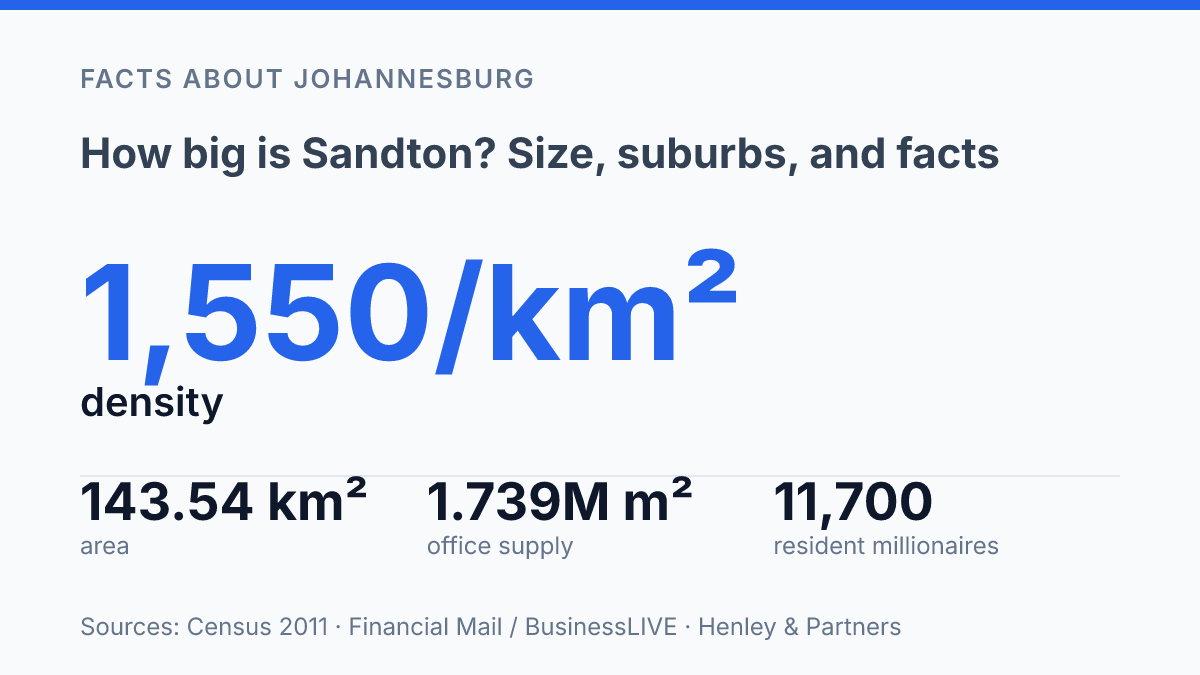
How big is Sandton is a stranger question than it sounds: the clearest Census boundary puts Sandton at just 143.54 km² in 2011, only about 8.7% of Johannesburg’s municipal area.
That should make it feel minor. It doesn’t. Sandton carries the visual and economic weight of a capital city district, with 1.739 million m² of office supply reported in 2025 and a skyline capped by the 234-metre Leonardo.
The trick is that Sandton means different things depending on who’s speaking. A planner sees a defined main place. A commuter sees a spread of suburbs.
A business owner sees the office core. In my honest opinion, that mismatch is the whole point. The real answer sits between the mapped boundary, the suburbs people fold into the name. The brand built from Sandown and Bryanston.
What Sandton is today
The odd thing about Sandton is that it looks like a city centre, sits inside Johannesburg, and still gets spoken about as if it were a town of its own.
Today, Sandton is a major financial, commercial, and residential hub in the northern part of the City of Johannesburg Metropolitan Municipality. That wording matters. You’re not dealing with one tidy suburb, but with a wider urban area that carries business districts, malls, apartment blocks, office towers, gated estates, and older residential pockets under the same familiar name.
Before it became part of greater Johannesburg, Sandton had its own municipal identity. The municipality was established in 1969.
That older status still shapes how people talk about the place. It feels separate, even though it now falls under Johannesburg’s metro government.
Its public image is anchored by landmarks more than boundary lines. Sandton City and Nelson Mandela Square do a lot of the work here. For visitors, shoppers, office workers, and tourists, those places are often “Sandton” in the practical sense: the spot they know, photograph, navigate to, and use as a reference point.
The business weight is even harder to ignore. Financial Mail/BusinessLIVE reported in 2025 that Sandton was South Africa’s largest business node, with 1.739 million m² of office supply.
That’s why the area can feel larger than its formal place on a map. A compact office core can project a much bigger identity than miles of lower-density housing.
But that creates the main confusion. People ask about one place, then discover Sandton behaves more like a cluster of suburbs and business nodes than a neat standalone town. In my view, that’s the key to understanding Sandton today: it’s less a single suburb and more Johannesburg’s northern power centre with a name everyone treats as shorthand.
How large the area really is
The cleanest boundary-based answer is much larger than most visitors expect: Sandton is not just the tower-filled core around its offices. A census area bigger than many small towns.
According to Census 2011 via Adrian Frith, Sandton Main Place covered 143.54 km², with 222,415 residents in 94,343 households. That works out to about 1,550 people per km². The number describes a spread-out urban area, not a dense inner-city grid.
Put that next to Rosebank and the difference becomes clearer. Rosebank reads as a compact district you can understand on foot.
Sandton, at this wider boundary, is a chain of suburbs, office zones, schools, malls, estates and arterial roads. You don’t cross it in the same mental category.
A tidy size figure looks helpful. It hides the real problem.
Sandton can mean the census main place, a specific suburb, the central business node, or the broader commercial district people refer to in everyday speech. Those aren’t the same shape on a map.
The 2000 municipal merger made that messier. After the restructuring, older local-government boundaries stopped matching how residents, property analysts and visitors used the name.
A property report might focus on the central office market, which Gmaven has demarcated at about 5.1 km². A census table uses the much larger main-place footprint.
In my honest opinion, the wider census figure is the best answer when someone asks about physical size, but it’s not the only useful one. If you mean the office core, Sandton is far smaller. If you mean the name people use for the northern commercial powerhouse, it stretches well beyond a neat suburb label.
Why Sandton feels bigger than it is
A handful of Sandton blocks can feel heavier than whole Johannesburg districts because the money, jobs, taxis, trains, and traffic all arrive at once. The Johannesburg Stock Exchange gives that feeling real weight. In 2026, the JSE said the combined market value of its listed companies had passed R24 trillion, so its presence isn’t just symbolic.
That financial pull is backed by the office towers around it. Investec, Nedbank, RMB and FirstRand all help turn central Sandton into a weekday machine. Discovery’s head office adds another kind of scale: thousands of workers, clients, deliveries, meetings, and rides all feeding the same streets.
The odd part is that this doesn’t make Sandton physically huge. It makes it intense. In my humble opinion, that’s why Sandton’s reputation feels bigger than its map outline: it concentrates decision-makers in a way most suburbs never do.
Movement does the rest. Rivonia Road, Grayston Drive, Sandton Drive, Katherine Street and the M1 links funnel people into a tight commercial core. The Gautrain Sandton Station adds a second rhythm, with airport passengers, office commuters and hotel guests stepping straight into the business district.
Sandton Central Management District has described daily movement through the district at about 300,000 people. That number matters because it’s not just residents. It’s the daily swell of workers, shoppers, drivers, security staff, cleaners, executives, visitors and commuters who make the area feel constantly occupied.
There’s a tradeoff, of course. The same density that gives Sandton its power also gives it its traffic, parking pressure and stop-start pace. It isn’t Johannesburg’s largest place by land, but on a weekday morning it can feel like the city’s center of gravity has been squeezed into a few hard-working blocks.
What the name Sandton means
Sandton sounds like a single old place name. It was stitched together from Sandown and Bryanston.
That matters more than a neat trivia answer. The name Sandton carries a split origin inside it, even when people use it today as one clean label.
The modern identity began to harden in the late 1960s. That was the period when a shared name started doing real work. It gave a collection of places a common public face, rather than leaving each suburb to stand alone in people’s minds.
The word itself is simple: “Sand” from Sandown, and “ton” from Bryanston. No grand mystery. But the result is oddly powerful, because a made-up blend now feels older and more fixed than many of the suburb names it sits above.
Here’s the tension: the name sounds like one suburb. It was built from two suburbs.
That split still shows up in the way people talk. Someone might say they’re going to Sandton, then mean an office block, a shopping area, a hotel district, or a quiet residential street several suburbs away.
That’s why the name sticks. It’s not just a point on a map.
It works as shorthand for a wider urban identity, even though the area contains many different neighbourhoods with their own names and character. In my view, that shorthand is useful. It also causes half the confusion around Sandton’s size.
So the name answers more than “where did the word come from?” It explains why Sandton can feel like one place in conversation and many places on the ground.
The origin is compact. The identity it created is not.
The size that matters isn’t only on the map
The practical move is to stop treating Sandton as one measurement. If you’re comparing suburbs, use the boundary.
If you’re judging economic pull, watch the office core, the wealth data. The institutions that make a small patch feel national.
That distinction will matter more, not less. In 2025, Johannesburg’s wealth story still leaned on Sandton. The JSE later reported listed market value above R24 trillion.
Those numbers don’t make every street richer or every block denser. They do explain the mismatch.
In my humble opinion, the real answer is that Sandton is modest in area and outsized in consequence. Measure the kilometres if you need the boundary. Measure the pressure if you want the truth.
Frequently Asked Questions
Q: How large is Sandton compared with Johannesburg?
A: Sandton sits in the northern part of the City of Johannesburg Metropolitan Municipality. It isn’t a separate metro anymore. That makes the comparison a bit tricky. The cleaner answer is that Sandton is a major city area inside Johannesburg, not a stand-alone city with its own metro boundary.
Q: What suburbs make up Sandton?
A: Sandton’s name comes from two suburbs: Sandown and Bryanston. Those names were combined when the area was identified as a distinct place. That origin matters because people still treat Sandton as one unit, even though it grew out of separate suburbs.
Q: Is Sandton a city or a suburb?
A: It’s both, depending on how you’re using the term. Sandton is a financial, commercial and residential city. It also sits within Johannesburg’s wider urban area. That split is the part people miss… and it’s why the area gets described so differently.
Q: Was Sandton ever its own municipality?
A: Yes. Sandton was formerly an independent municipality before it became part of Johannesburg’s metro structure. That history still shapes how people talk about it today, especially when they’re comparing its size and status to nearby areas.
Q: Why is Sandton so important in Johannesburg?
A: Sandton matters because it carries major financial, commercial and residential weight inside the city. It’s not just a rich district. It’s a core business area with a strong identity. In my view, that’s why questions about its size never stay simple for long.