
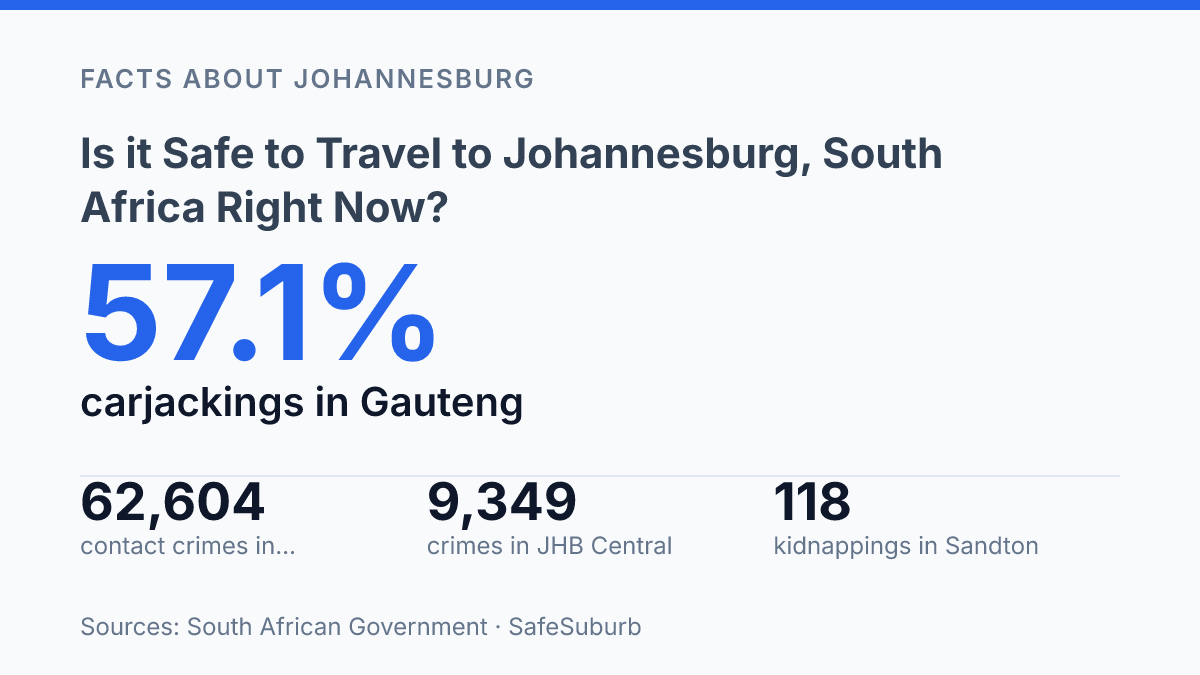
Is it safe to travel to Johannesburg, South Africa right now? The answer changes 9.9 times between Rosebank and JHB Central, based on Apr 2025-Mar 2026 reported crime counts. That gap matters more than any simple yes or no.
The U.S. Department of State still places South Africa at Level 2, not a do-not-travel warning. But Australia tells visitors to use a high degree of caution, and SAPS data from 2026 puts Gauteng at 57.1% of South Africa’s carjackings in one quarter. Johannesburg is not a city where vibes are a safety plan.
The useful question is narrower. Where will you stay? How will you leave OR Tambo?
What happens if dinner ends after dark? In my honest opinion, the safest travelers here aren’t the bravest. They’re the least casual. This guide cuts through advisories, neighborhood risk, common crimes, and transport choices without pretending every part of the city carries the same odds.
What current travel advisories actually say
No major English-speaking government is telling tourists to avoid Johannesburg outright, but none treats it as a casual city break either.
The U.S. Department of State rates South Africa Level 2: exercise increased caution, citing crime, terrorism, unrest, and kidnapping. Its advisory also says violent crime is more common in downtown areas of big cities, especially after dark. That matters for Johannesburg, where your risk can change sharply by hour, route, and neighborhood.
The UK Foreign, Commonwealth & Development Office is more pointed about the city itself. It warns that violent crime is a serious problem and singles out carjackings in Johannesburg. It also says criminals have followed travelers from OR Tambo International Airport to their destination and robbed them, often at gunpoint.
That is not a reason to panic. It is a reason to pre-book airport transport and avoid improvising when you land.
Australia’s Smartraveller takes a similar line. It tells visitors to exercise a high degree of caution in South Africa due to violent crime, including robbery, assault, drink spiking, and carjacking. The warning gets sharper for major city centers, township areas, and travel after dark.
Canada’s advice adds a transport-specific warning. As of July 13, 2026, the Government of Canada said Johannesburg’s main train station and the surrounding area are dangerous due to high crime rates. It also limits its confidence to a small set of safer rail services, rather than treating public transport as broadly reliable.
The official answer is not don’t go. It is plan as if small mistakes can carry real costs. In my view, that distinction is the key to reading these advisories correctly: Johannesburg is visitable. It rewards prepared travelers and punishes casual ones.
Where visitors are safest, and where risk rises fast
Rosebank recorded 945 reported crimes in SafeSuburb’s SAPS-based data for Apr 2025–Mar 2026, compared with 9,349 in JHB Central. That makes the central precinct’s count about 9.9 times higher. The gap explains why visitors tend to do better in hotel-heavy, managed districts rather than drifting into the city core without a plan.
The more manageable bases include Rosebank, Sandton, Melrose Arch, and parts of the airport corridor near secured hotels and pre-booked transfers. These areas give you easier access to restaurants, malls, offices, hotel security, and controlled parking.
None of them is risk-free. They reduce the number of exposed moments you create for yourself.
Sandton proves the tradeoff. It looks polished, and in many ways it is easier for visitors than central Johannesburg.
But SafeSuburb data still recorded 6,645 reported crimes there in the same 12-month period, including thefts from vehicles, aggravated robberies, common robberies, and kidnappings. A glass lobby doesn’t protect you once you step outside distracted, flash a phone at the curb, or accept the wrong ride.
Risk rises fast in predictable situations: the CBD after dark, isolated ATMs, quiet side streets, informal ride hails, and any walk that takes you away from lit commercial areas. The same trip can feel normal at 2 p.m. and reckless at 10 p.m. That shift matters more than many visitors expect.
Your hotel choice, transport choice, and timing shape your exposure. Pick accommodation where you can eat, meet drivers, and return without improvising. Use arranged transfers or reputable app-based rides that match the car and driver shown in the app. In my honest opinion, hotel location matters more in Johannesburg than in most big tourist cities, because one bad logistical choice can move you from a controlled zone into a high-risk situation in minutes.
Common crimes travelers need to plan for
A red traffic light can be riskier than a crowded bar in Johannesburg. The threat that catches visitors out is often not a dramatic confrontation. It’s the ordinary pause: a phone in your hand, a window down, a bag visible, a stranger too close at an ATM.
Official advisories keep naming the same serious crimes for a reason: violent robbery, carjackings, and express kidnappings. In South African Police Service figures for January 1–March 31, 2026, Gauteng recorded 57.1% of the country’s carjackings, according to SAPS crime statistics.
That doesn’t mean every drive is dangerous. It does mean your habits inside and around a vehicle matter more here than they do in many cities.
Muggings and phone snatches usually depend on speed, distraction. An easy exit.
They happen in busy places where you assume crowds protect you, and in quiet spots where no one can step in. Pulling out a phone on a pavement, checking directions at a curb, or lingering outside a venue can make you look available.
ATM scams follow a similar pattern. Someone offers help, creates confusion, watches your PIN, or swaps a card before you realise what happened.
The safer choice isn’t just “use an ATM indoors.” It’s to use one inside a guarded bank, mall, or hotel, then put the cash away before you walk out.
The biggest danger isn’t always the crime that sounds worst on paper. A carjacking or express kidnapping is the nightmare scenario, but smaller choices can lead there fast. In my humble opinion, the most underrated risk is acting as if a short stop doesn’t count as exposure.
Airports, traffic lights, petrol stations, and parking areas deserve special attention. Opportunistic thieves look for luggage, rental cars, distracted arrivals, and drivers who don’t know where they’re going. Keep bags out of sight, doors locked, windows up, and your route set before you move.
Parking lots can feel controlled. That feeling can mislead you. Don’t sit in a parked car sorting messages or counting money.
Get in, lock up, and leave. Or arrive, check your surroundings, and go straight inside.
How to move around without making yourself a target
The safest ride in Johannesburg is often the one you arranged before your plane took off. Ask your hotel to book a vetted transfer, or use a pre-booked ride from a known operator with the driver’s name, plate, and pickup point confirmed in writing.
Don’t improvise at the kerb after a long flight. That’s when tired travelers make expensive decisions.
Convenience will tempt you. A cheaper ride, a short walk, or a late dinner across town may look harmless on a map.
But the safer choice is usually less convenient. That tradeoff buys you control when the city feels unpredictable. In my view, the boring transfer is usually the smartest money you spend in Johannesburg.
Daylight helps. Plan intercity moves, airport runs, and unfamiliar routes before dark where you can. If you need to move at night, keep the route simple: hotel lobby to car, car to entrance.
No wandering to find a better fare. No waiting outside with luggage.
Your phone is a tool, but it’s also a signal. Set your route before you step outside, then keep the device out of sight. Use one card for daily spending, keep cash low and hidden, and leave watches, chains, and flashy bags in the hotel safe.
The goal isn’t to look scared. It’s to look unrewarding.
Intersections and parking lots deserve your full attention. Keep windows up, doors locked, and bags off seats. When you stop, scan the people around the car before you check messages or search for parking tickets.
If something feels wrong, leave. You don’t owe the situation politeness.
Rail can work, but choose carefully. Official travel advice narrows safer rail options to 4 services, and for most visitors Gautrain is the practical name to check first.
Still, confirm the station, last train time, and onward pickup before you commit. A safe train ride can become messy if the final ten minutes are unplanned.
Before arrival day, ask your hotel three direct questions: who handles transfers, how guests enter after dark, and what number you call if plans change. Save emergency contacts offline, including 112 from a mobile phone, and get local SIM or eSIM access as soon as possible.
Preparation won’t make the city risk-free. It does make you harder to read, harder to follow, and faster to help.
Why your route matters more than your nerve
Treat Johannesburg like a city where logistics are part of the itinerary, not an afterthought. Before you book, map your first two rides: OR Tambo International Airport to your hotel, then your hotel to dinner. If either route relies on guessing, fix it before you fly.
Canada’s advice last updated July 13, 2026 names only 4 rail services as safe and reliable, including Gautrain. That tells you something blunt. Public transport isn’t a place to improvise outside the named options, even if the distance looks short on a map.
In my humble opinion, Johannesburg rewards travelers who plan with respect, not fear. The mistake is treating a safe suburb as a safety system.
Frequently Asked Questions
Q: Is Johannesburg safe for tourists right now?
A: Yes, but only if you stay alert and make smart choices. Travelling to Johannesburg requires exercising a high degree of caution due to high rates of serious crime, yet many visitors get around safely by sticking to secure areas and avoiding risky situations. In my view, the mistake people make is treating it like an ordinary city break.
Q: What do official travel advisories say about Johannesburg?
A: Major government advisories, including the U.S. Department of State, recommend exercising increased caution. Other countries warn about violent crime, carjackings, and express kidnappings. The advice is consistent even if the wording differs. increased caution is the key message, not a full travel ban.
Q: Which areas of Johannesburg are safer to stay in?
A: Secure neighborhoods and well-managed hotels are the safest choice. That doesn’t mean every other area is off-limits. You should be more selective than you would be in many other cities. secure areas matter more than chasing convenience.
Q: What crimes should travelers watch out for in Johannesburg?
A: The main risks are serious crime, carjackings, and express kidnappings. Those threats sound harsh because they are. They don’t mean every trip goes wrong. They mean you need to plan transport, timing, and routes carefully. violent crime is the biggest concern for most visitors.
Q: Can I travel to Johannesburg safely if I’m careful?
A: Yes, you can. The city can be safely visited if you avoid high-risk behavior, keep to secure areas, and stay aware of your surroundings. high degree of caution is the right mindset, and serious crime is the reason that caution matters.